
The year 2025 marked a global shift from climate ambition to coordinated action across national and local governments.
In 2025, the world marked ten years since the Paris Agreement and gathered in Belém for COP30. It also became a turning point for how climate ambition is delivered on the ground. The Coalition for High Ambition Multilevel Partnerships (CHAMP) moved decisively from political alignment to operational delivery – positioning multilevel governance as a core pillar of global climate action.
Since its launch at COP28 in 2023, CHAMP has grown into a global platform for cooperation between national and subnational governments in climate policy, finance, and implementation. By the end of 2025, CHAMP included 78 endorsers, including the European Union, representing nearly 36% of the global population, 69% of global GDP, and 40% of global emissions – underscoring its rising role in the international climate architecture.
A new wave of global endorsements
In 2025, momentum accelerated with a powerful new wave of endorsements. The European Union formally endorsed CHAMP ahead of COP30, reinforcing cities and regions as indispensable partners in delivering the Paris Agreement. Earlier in the year, Tunisia joined in February, signaling growing momentum for multilevel climate action across Africa and the Mediterranean. In August, Sweden and Bolivia were added to the coalition, bringing their unique approach to climate action from industrial decarbonization and urban innovation in Scandinavia to frontline resilience and Indigenous-led climate stewardship in the Andes and the Amazon. Together, these endorsements confirm that multilevel climate action is now a shared global priority.
From commitment to delivery: a new governance phase
At COP30, CHAMP formally entered its implementation phase with the announcement of a new country-led governance framework and the launch of the Plan to Accelerate the Solution (PAS) on Multilevel Governance. Brazil and Germany were named the coalition’s first Co-Chairs, guiding CHAMP’s work through 2027.
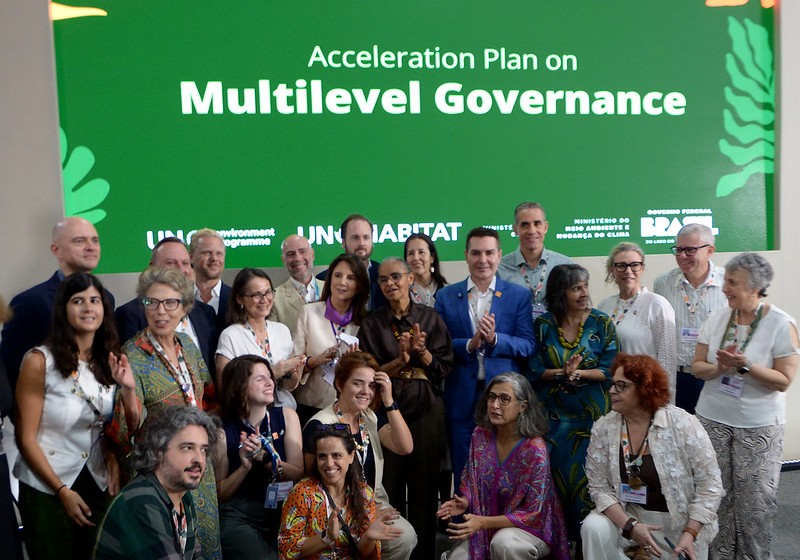
The PAS is the first global effort of its kind to institutionalize multilevel climate governance as a permanent enabling condition for Paris Agreement implementation. Coordinated by the COP30 Presidency and the Government of Brazil in collaboration with UN-Habitat and other CHAMP partners, it links political commitment with practical delivery across policy, capacity building, and finance.
By 2028, the PAS targets:
- 100 national climate plans and NDC implementation plans incorporating formal multilevel governance mechanisms (with a goal of 120 by 2030);
- 6,000 public officials trained in CHAMP-endorsing and partner countries to accelerate climate delivery.
This shift marked a decisive step: CHAMP is no longer only a political declaration – it is now an operational system for climate implementation.
Cities are delivering at scale
A new joint C40–GCoM assessment released at COP30 confirmed what this multilevel approach is already unlocking: cities are delivering climate action at unprecedented speed and scale, particularly in CHAMP-endorsing countries.
Over the past decade:
- Mitigation actions increased nearly tenfold, reaching 4,723 actions in 2024;
- Adaptation actions also increased tenfold;
- Cities now address nearly 85% of their high-risk climate hazards, up from 69% in 2019;
- 61% of cities in CHAMP countries with long-term data are on declining emissions pathways;
- 73% of C40 cities have peaked emissions;
- If fully delivered, city commitments could close up to 37% of the global 1.5°C ambition gap by 2030.
In CHAMP countries alone, building-sector policies have already cut urban emissions by one-fifth since 2015, outperforming reductions from national electricity grids over the same period.

NDC 3.0 Signals a Multilevel Shift
This acceleration of local delivery is increasingly reflected in national climate planning. The 2025 United Nations Framework Convention on Climate Change (UNFCCC) Nationally Determined Contributions (NDC) Synthesis Report shows that:
Key signals from the first cycle of NDC 3.0 include:
- Four out of five national climate plans now reference subnational governments – a 19% increase from previous cycles;
- Nearly two-thirds recognize cities and regions as partners in planning, implementation, and monitoring;
- About half of all NDCs submitted so far come from CHAMP-endorsing countries, many explicitly linking city action to national targets and financing frameworks.
Together, these trends confirm a growing global consensus: climate ambition cannot be delivered from national capitals alone.
Looking Ahead: 2026 and the Global Scale-Up of Multilevel Delivery
By the close of 2025, CHAMP had shifted from a coalition of the willing to a coalition of doers. With nearly 80 national governments on board, a new country-led governance model, the PAS as a global implementation engine, and strong evidence that cities are already delivering at scale, the foundations are now in place for the next phase of climate action.
As countries move from NDC commitments to full implementation and climate finance mobilization, multilevel governance is no longer a parallel approach – it is becoming the standard for effective climate delivery.
The task ahead in 2026 is clear: scale what works, deepen national–local integration, and ensure cities have the finance, authority, and institutional support to turn ambition into lasting transformation.